
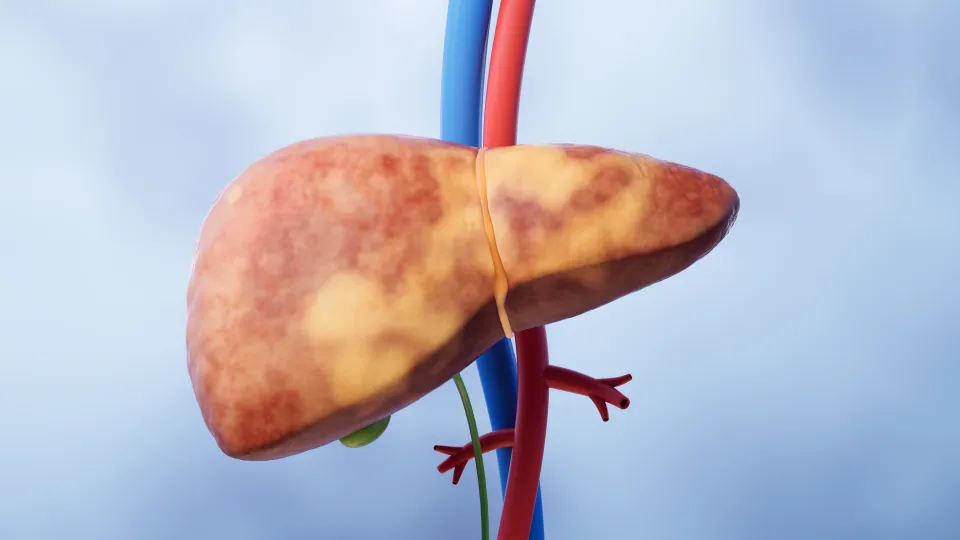
The liver disease MASLD affects around 30 percent of adults worldwide and is closely associated with obesity. The liver condition, formerly called nonalcoholic fatty liver disease (NAFLD), can affect people with type 2 diabetes and other metabolic conditions. People with MASLD can develop liver fibrosis, which can lead to more serious conditions, such as liver cirrhosis and liver failure.
Liver fibrosis is a build-up of scar tissue in the liver, and can be present at any stage of MASLD, and is key prognostic marker of MASLD progression. More research is needed to understand the key transitions driving MASLD progression and develop new treatments. Early detection and preventive measures can prevent MASLD from leading to more serious forms of liver disease, such as MASH (metabolic dysfunction-associated steatohepatitis). A new study, published in the scientific journal eLife, presents new findings that may lead to better treatment of MASLD in the future.
“Metabolic dysfunction-associated steatotic liver disease has several stages. Early treatment can slow down or reverse liver damage at the earlier stages of the disease. Once the disease has reached the fourth and final stage, it is no longer possible to stop the progression. MASLD is currently treated with a healthy diet, physical activity and weight loss, but there is currently no medical treatment of the disease. In our new study, we have identified a possible treatment target," says Philipp Kaldis, professor of metabolic disorders and liver disease at Lund University Diabetes Centre (LUDC), who led the study.
Altered gene expression
The international research team analysed samples from obese people in Australia before bariatric surgery was performed. Of the 109 participants, 76 had early stage of MASLD, whereas the other 33 participants showed no signs of the disease. The researchers performed gene expression profiling of liver samples and an analysis of metabolites in liver- and blood samples to gain a better understanding of fibrosis progression.
These analyses made it possible to study the molecular landscape of MASLD in obese individuals. The researchers divided individuals with MASLD into two groups that they studied more closely – one group with MASLD and no liver fibrosis and another group with MASLD and liver fibrosis. The researchers found that the expression of specific genes, which can be linked to GTP-binding proteins, is altered in the liver of individuals with MASLD and fibrosis. Corresponding changes in gene expression could not be seen in individuals with MASLD who did not have fibrosis. The research team also treated human cells with GTPase inhibitors, and found that the treatment reduced the secretion of collagen, which is associated with fibrosis.
“In our new study, we have managed to link the altered gene expression to liver fibrosis. We have already proceeded with new studies where we study the mechanisms in detail to investigate whether we can establish a causal relationship. We hope that this knowledge may lead to new treatments in the future. If researchers develop a drug that inhibits the gene expression from being altered, and this would reduce the formation of liver fibrosis, then this could be a new treatment option," says Philipp Kaldis.
Need for increased knowledge
The study is the result of an international collaboration which started by coincidence, when Philipp Kaldis reached out to researcher Matthew Watt from the University of Melbourne about another paper. The researchers started to discuss the possibility of using the Australian cohort of obese patients to study the progression of MASLD. Hyungwon Choi at the National University of Singapore was engaged for the multiomics analysis, while Volker Lauschke at Karolinska Institutet contributed with three-dimensional models with cells from a group of individuals with MASH. Through these cell models, the researchers were able to experimentally validate their findings.
“The study would not have been possible without this collaboration. There is a great need for increased knowledge of how liver diseases can be prevented and treated. MASLD is a disease that typically causes no symptoms, which means that the disease can go undetected and progress to more serious stages. Of course, this is a major problem for individuals who already have other systemic diseases, such as type 2 diabetes," says Philipp Kaldis.